
Capital Chorus & Conductor Coaching
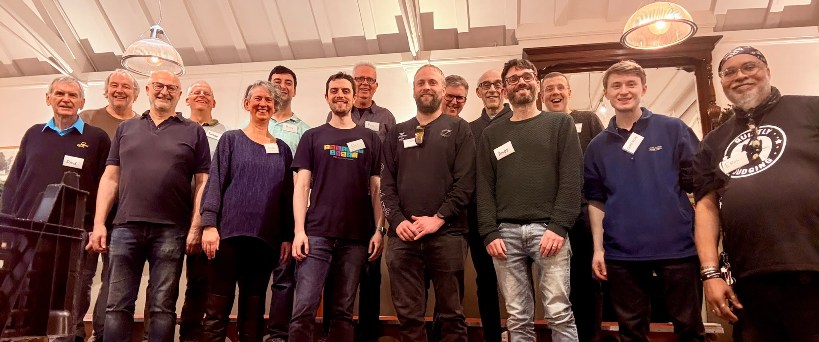
I spent Saturday in West London with Capital Chorus, coaching both the singers and their musical director. We were nominally working on their contest set for BABS Convention next year, but since the performance date is still a long way off, our focus was more on skill development, with the two songs serving as convenient vehicles through which to do so.
We started the day exploring the idea of ‘theme’, in the distinctive way the barbershop world uses the term to mean a song’s leading element. Their ballad had qualities that made harmony and lyric viable contenders, but the melody is fundamentally the things that stays with you when the detail recedes to the background. Simply identifying this transformed the way the chorus delivered the song: shape and direction and nuance all came to life.
Our work here was not yet done, however. We used bubbling as a way for the singers to connect directly with the melodic flow of their lines, while at the same time providing a much clearer feedback mechanism to their MD Oli about his conducting. I brought his attention to way he approached his ictus, with the goal keeping the tone alive and connected into each pulse point.
Once we had increased the connection here, we switched into the singers only singing the vowels. The goal here is not simply to connect sound to sound keeping the tone alive when not interrupted by consonants, but to find a consistent resonant space for those vowels to live in. When playing the guitar, you don’t change the shape of the box every time you change a chord; likewise in singing, you want the jaw and tongue to stay placid so that the resonant space creates a common ground for all vowels to live in.
Along with this work for the singers, Oli was tasked with considering the consistency of his hand shape: there is a strong correlation between variation in the relationship between a conductor’s fingers, hands, and wrists and excessive variation in the vowel shapes their singers produce. We can use this to our advantage and reduce overactive enunciation by a kind of metaphorical mapping from hand to vocal mechanism.
It’s always fun working with a chorus and their director together, as you can get both parts of the equation working together to common artistic and technical goals. And it’s even more fun when you don’t let the chorus hear what you’re asking the MD to do, and you can still hear a significant upgrade in the sound. This makes it clear that it’s the change to the conducting that is having the impact, not just the singers being helpful (useful though this is of course!). Sometimes the singers could spot what the change was, other times it was intriguingly unclear: they could hear and feel the difference, but couldn’t specifically identify what it was.
Where conducting coaching gets really interesting is when you can shift away from making technical interventions to things such as hand shape towards making mindset interventions, where you ask them to change what they’re thinking and trust their wonderful intuitive brains to make the micro-adjustments needed to make that change manifest. A significant one of these, which had also been relevant when working with Bristol A Cappella a couple of weeks ago, was the shift from feeling he had drive the music, to letting the music come to him. The change of intention transforms the conductor’s way of being in the world in myriad subtle ways that you could never control individually, producing a holistically more integrated posture, and thus eliciting a commensurately more integrated sound.
Another key moment was when I asked Oli to send freeing-up thoughts towards the leads. They were working hard, and whilst they were succeeding in the outward task we were addressing as a chorus, that effort was introducing small tensions that were affecting tone and tuning. When Oli telepathically projected calm and freedom towards them, they shed these tensions and slotted back into their place of poise, sounding quite glorious. I don’t think we actually told them on the day what he had done here, just celebrated the magic.
But this is really where the heart of conducting lies: helping it all sound better from within the flow of the music, without having to stop and tell people what to do. Of course, you do sometimes need to stop and tell people what to do, but the more you can do in real time as you make music, the more the work becomes both more efficient and more pleasurable. The key question here for the conductor’s mindset is: What does this need?


You may also like ...
|
Node 3,080
Weight = 7. Common link to https://www.singbarbershop.com/ (2), Links to Exploring Gesture and Voice with Bristol A Cappella (2), Three tags in common [22 posts have this] A Cappella, Coaching, Conducting (3) 
|
Node 3,024
Weight = 5. Common link to https://www.singbarbershop.com/ (2), Three tags in common [22 posts have this] A Cappella, Coaching, Conducting (3) 
|
Node 2,433
Weight = 4. Common link to https://www.singbarbershop.com/ (2), Two tags in common [224 posts have this] A Cappella, Coaching (2) 
|
Node 670
Weight = 4. Links to The Tea-Towel Test (2), Two tags in common [224 posts have this] A Cappella, Coaching (2) 
|
...found this helpful?
I provide this content free of charge, because I like to be helpful. If you have found it useful, you may wish to make a donation to the causes I support to say thank you.
Archive by date
- 2026 (33 posts)
- 2025 (24 posts)
- 2024 (46 posts)
- 2023 (51 posts)
- 2022 (51 posts)
- 2021 (58 posts)
- 2020 (80 posts)
- 2019 (63 posts)
- 2018 (76 posts)
- 2017 (84 posts)
- 2016 (85 posts)
- 2015 (88 posts)
- 2014 (92 posts)
- 2013 (97 posts)
- 2012 (127 posts)
- 2011 (120 posts)
- 2010 (117 posts)
- 2009 (154 posts)
- 2008 (10 posts)
