
Arranging Flexibly for Workshops
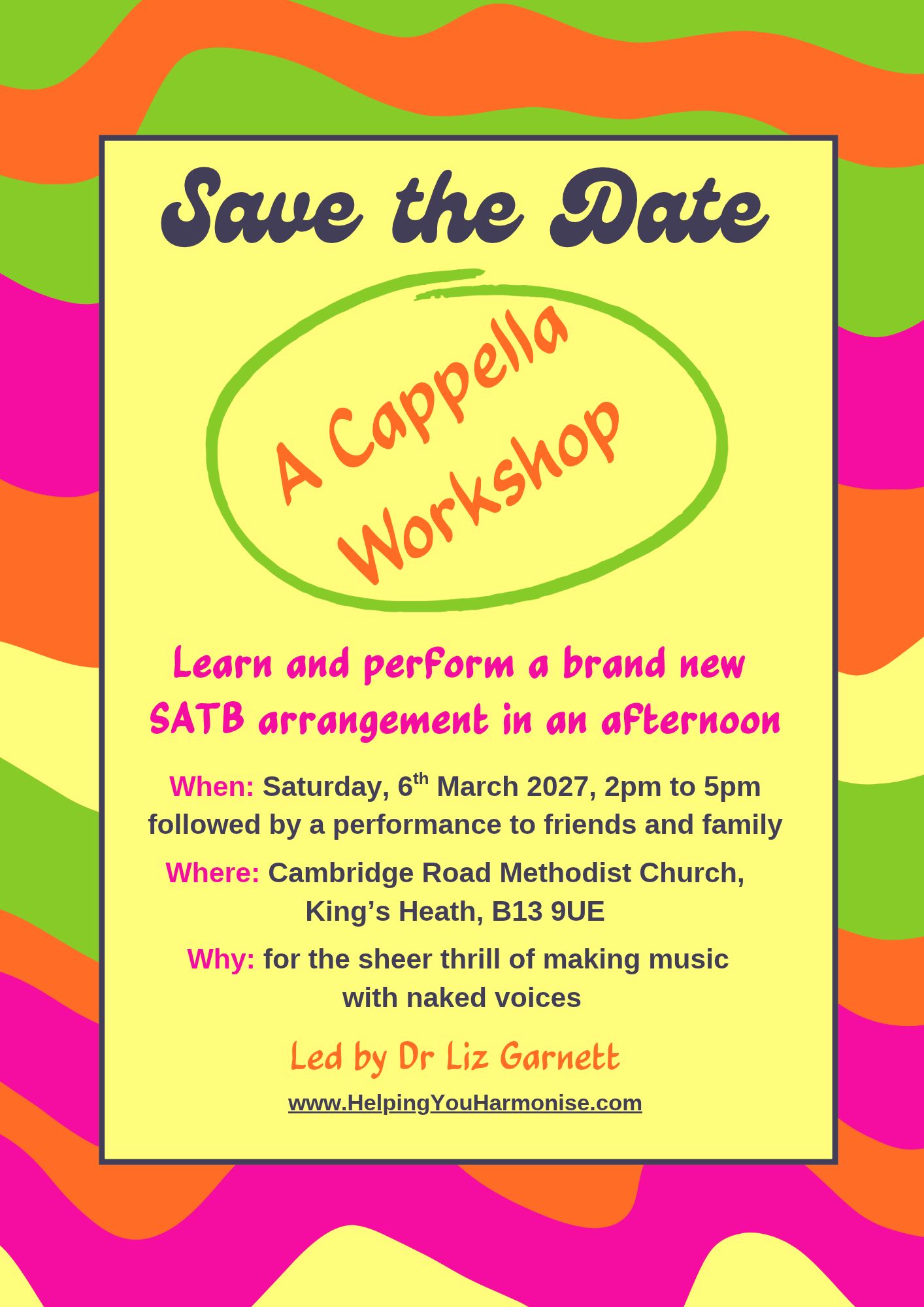 Having set a date to run a standalone a cappella workshop in the Spring, I have been turning my attention to arranging music for it. There are specific challenges and opportunities in arranging for these kinds of occasions, and it really keeps you honest. Anything that the singers can’t do will not only be your fault, but also your responsibility to sort out, so developing teaching strategies goes hand-in-hand with the actual arranging. It’s a great discipline.
I started doing this in the early days of Magenta, when we had been asked to present a concert as part of a local festival, but were as yet too new to have enough repertoire to support a whole performance event. So we ran a workshop instead, at which we did perform the few songs we had by then, but spent the rest of the time learning a new arrangement with our guests.
It was a fun way of spending an evening, and whilst we did subsequently occasionally put on full concerts, the workshops became a regular feature in our offerings. In the early days it was a also a great recruitment tool – we’d learn a cut-down version of a song at the workshop, and then introduce the full version so that new joiners who had enjoyed the taster could feel like they already had a head-start on the process.
(In later years, as our general repertoire became more challenging, this process was less smooth, as there was a gradually increasing disjunction between the difficulty of the music we’d use to learn in a workshop and the music new joiners were faced with in the rest of the repertoire. But we still made it work.)
Arranging for next Spring’s workshop is drawing heavily on these experiences, but there are ways in which the challenges are somewhat different from the Magenta years. The first is in trying to work out how much music, of and what difficulty, to bring to the party. At the Magenta workshops, we learned everything from scratch on the day, but I was working with an established group who had shared experience of learning methods and thus could support guests and help them navigate the process. I also knew the pace of learning to expect with these people and could gauge how much music we’d get through with some accuracy.
For my upcoming workshop, I don’t actually know who will be coming. I have a few people who have expressed pretty secure interest so I’m confident we’ll have people to make music with, and that at least some of them will have singing experience, but they don’t have the kind of shared background a regular group develops. So the rate of learning is uncertain.
On the other hand, I am planning to issue learning materials in advance so that those who are of the mindset to prepare ahead can do so. This significantly increases the amount of music and/or complexity it is possible to get through in an afternoon. Although of course one can’t predict how much, or how effectively, people will prepare, so one can’t assume that the full potential for more ambitious content can be realised.
The solution I am working on is therefore to build an arrangement that is somewhat modular. There will be the ‘executive summary’ version, which is short and avoids too much complexity, and will be learnable from scratch if nobody has done any prep. There will be the ‘abridged version’ which is longer and somewhat more embellished, and will be a realistic goal for a group in which a majority have done some learning ahead of time. And there will be the full version that I wouldn’t necessarily expect to be possible in the time available, but is worth creating to make available in my catalogue, and offers a stretch goal if people turn up feeling particularly intrepid.
In all these arranging decisions, I am anticipating the juggling act of creating an experience that is challenging enough to lift the participants without being so challenging as to overwhelm them. The aim is for people get the satisfaction of feeling like they have achieved something special.
The other arranging challenge I am facing for this one is balance of parts. Magenta was an upper-voice close-harmony choir, and we were accustomed to all singing different parts in different songs. So, not only was I arranging within ranges that were all pretty much accessible to all participants, I had a core of singers who could adapt around the part choices of our guests to make the balance work on the day. Also, learning from scratch without prior prep meant we could make the most of this flexibility.
With an SATB texture, you are much more at the mercy of who ends up signing up for the workshop. The strategy I am taking to cope with this is to be very conservative with the ranges for each part, to make it possible for people to switch out of their regular part to make the balance work. So, the alto line doesn’t go too low for second sopranos, nor the soprano too high for first altos; likewise between tenors and basses. The tenor line, meanwhile is very accessible to second altos – female barbershop basses will feel very at home there.
When people sign up, I’m going to ask them to let me know their first and second choices for parts. I’ll be able to keep an eye on balance, and if we need people to shuffle around to keep things reasonably in kilter. I know not everyone is comfortable switching parts, but we don’t need everyone to; those who enjoy that kind of challenge can do the honours for us.
I am working on the assumption that it is likely to be lower voices we are short of. This is partly because of the general stereotype of the choral world, although I note that the generalisation does not hold for LGBT+ choirs; there was a glorious phase in my time with Rainbow Voices when we were contending with the balance challenge of more tenors than anyone else. But it’s also a factor of my own personal musical networks; having run an all-female choir locally for a decade, and being involved in women’s barbershop nationally, my musical friendship groups tend to be upper-voice heavy. So I want the tenors and basses who sign up to feel the balance is being managed such that they can shine too.
Another option for flexible arranging would be to write a 3-part chart that carries the full musical argument, with an optional bass line for spritz and extra groove. That wasn’t my first instinct when I started identifying the challenges, probably because my instinct as an arranger is to make sure everyone gets some candy, and defining one part as inherently expendable doesn’t feel like it fits that principle. But it’s something I’m bearing in mind to try some time, as a technical exercise if nothing else.
Anyway, if you’re in travelling distance of Birmingham on 6 March 2027, you can come along and see how it all works out. More details to follow.


You may also like ...
|
Node 1,961
Weight = 3. Three tags in common [11 posts have this] A Cappella, Arranging, Learning (3) 
|
Node 2,622
Weight = 3. Three tags in common [11 posts have this] A Cappella, Arranging, Learning (3) 
|
Node 2,809
Weight = 3. Three tags in common [11 posts have this] A Cappella, Arranging, Learning (3)
|
Node 1,832
Weight = 3. Three tags in common [11 posts have this] A Cappella, Arranging, Learning (3)
|
...found this helpful?
I provide this content free of charge, because I like to be helpful. If you have found it useful, you may wish to make a donation to the causes I support to say thank you.
Archive by date
- 2026 (29 posts)
- 2025 (24 posts)
- 2024 (46 posts)
- 2023 (51 posts)
- 2022 (51 posts)
- 2021 (58 posts)
- 2020 (80 posts)
- 2019 (63 posts)
- 2018 (76 posts)
- 2017 (84 posts)
- 2016 (85 posts)
- 2015 (88 posts)
- 2014 (92 posts)
- 2013 (97 posts)
- 2012 (127 posts)
- 2011 (120 posts)
- 2010 (117 posts)
- 2009 (154 posts)
- 2008 (10 posts)
