
Musical Identity

On ‘Not Being Able to Sing’

I have had conversations recently with three different women about the phenomenon of ‘not being able’ to sing. Each had brought the identity of ‘non-singer’ with them from childhood, but each now had a different relationship with that identity.

The first has been singing in a choir for a few years now. She joined when she was in her fifties, having believed since the age of 11 that she couldn’t sing, because somebody had told her so. But she always rather wanted to nonetheless, so went along to join the choir with much trepidation and discovered to her pleasure that she could after all.

The second was a participant in a workshop I ran recently who had come along to accompany her daughter. She confessed to enjoying the session, but was worried that she was spoiling it, because she couldn’t sing. ‘But of course I sing to my daughter,’ she mentioned as an afterthought.

The Great British Barbershop Boys: Going ‘Mainstream’

ChristmasTimeThe Great British Barbershop Boys’ Christmas album is due out on Monday, and both the media appearances and availability of samples are ramping up in anticipation. And I’m enjoying observing the responses of the barbershop world with that double vision of both a now-well-established member of it and a musicologist who has spent many years documenting it.

Predictably, there is much excitement.

Hostage-to-Fortune Songs

There is a certain type of song that has offers a specific type of trap to the performer. These are songs in which the lyric makes an explicit commitment to a certain expressive quality or type of characterisation in such a way that really draws attention to itself if the performers’ musical rendition doesn’t quite achieve it.

The classic example is ‘I Got Rhythm’. If you don’t got rhythm, it shows. Similarly, if you ain’t got that swing, your performance of Duke Ellington’s classic is unlikely to be meaningful. Indeed, any song whose lyric describes one of its constituent musical elements is simultaneously telling the performers how they should sing it and telling an audience the criteria by which they should judge that performance.

Accent and Timbre

starsandstripesunionjack
There are comments going back nearly 100 years in the literature on choral music about differences in vocal sound between British and American choirs. Back in 1914, Henry Coward was making the following comments:

There is no doubt that, generally speaking, the English choral singer favours a backward voice-production (p. 39).

Of course one must always be careful to avoid excess of nasality, or more harm than good will result; but I must say that, except in two cases in the United States, where the people have an excess of nasality in speaking, I never yet heard a choir go beyond the limits of good tone in the way of nasal resonance, whereas one often hears excess of throatiness in England (p. 44).

The Conductor’s Circle of Influence

circlesI have a lot of conversations with choir directors, and one of the things I’ve noticed is that there is a strong correlation between how happy or unhappy the director is with progress and how much they refer to the choir as ‘we’ or ‘they’. Choral leaders face myriad potential difficulties: do the singers turn up regularly and on time?; do they retain what they’ve learned one week to the next?; do they pay attention during rehearsal?; do they watch the conductor?

Every choir faces variants of these challenges at their own particular level. But directors seem to feel more frustrated about them if they are framing them as problems with the behaviour of the (implicitly errant) singers rather than problems with the culture of the choir as a whole, including the director.

LABBS at Llandudno

Venue Cymru, LlandudnoVenue Cymru, LlandudnoThis weekend saw the 2010 LABBS Convention in Llandudno. The chorus contest was exceedingly closely-fought, with only 13 points in total (out of a possible 1800) separating first and third places. The quartet contest was clearer-cut for the outright winner (last year’s bronze medallists, Miss-Demeanour), but it was hard to predict who was going to pick up the bronze medal.

(On a personal note, I was pleased to see the three competing choruses I had coached during September come away with prizes. Amersham A Cappella landed gold medals, Green Street Blues picked up bronze, and Bristol Fashion received the Peter Caller award to celebrate their scores moving from ‘division 2’ level up into ‘division 1’.)

Questions of Blend

A recent comment on a post from last year asked the following question:

I have tried twice without success to join choirs that do 3 and 4 part harmony. I get rejected after a few sessions as i am told my voice does not blend. I know I have a good singing voice and i am very motivated, although I do not understand very much about music theory

The last attempt did not lead to any criticism from the coach but from the other singers near me. I am puzzled as to the possible cause of non blending. Any advice?

I felt it was one of those questions that deserves a post (or possibly a book) in its own right.

123…Come & Sing!

123sing
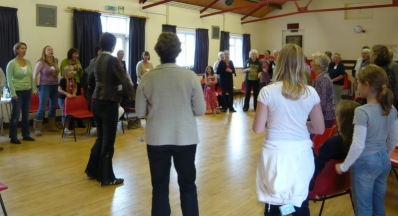
Last weekend saw singing events taking place all over the UK as part of Classic FM's 123sing! project. My contribution to the extravaganza was leading a Come & Sing workshop in Appleton, a medium-sized village in Oxfordshire. The workshop was organised and hosted by Harmony InSpires, the ladies barbershop chorus that rehearses in the next village, and through a combination of leafleting, advertising and word-of-mouth they pulled in a good sized group of participants.

...found this helpful?

I provide this content free of charge, because I like to be helpful. If you have found it useful, you may wish to make a donation to the causes I support to say thank you.


Archive by date

Syndicate content Syndicate content