Conducting

How to Get a Response from an Unresponsive Choir

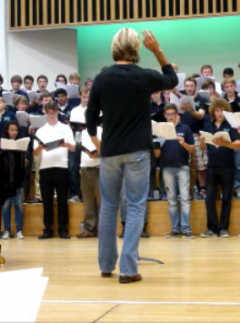
It is something that all choral conductors will have experienced at some point: starting a rehearsal and finding the choir completely lacking in energy. Eyes are down, body language is closed, words are mumbled and the sound projects about 3 inches before falling to the ground. The question is: what does the director do to change this?

The first instinct is usually to inject oomph: with bigger, more emphatic gestures and a bright cheery tone of voice we attempt to chivvy the singers into life. If it is a usually responsive choir that’s just having a randomly dozy day, this will work just fine. But if the unresponsiveness is a common experience with the group, then chivvying becomes counter-productive. You can find yourself with one of two scenarios:

Conducting Gesture: The Choir as Co-Author

gesture_voice.JPGThe title of this post is a parody of the title of a paper by Jürgen Streeck about how people use gestures in conversation. The substance of his study was to show that gestures are not merely part of the way we broadcast our ideas as we express them to others, but are influenced by the way our interlocutors are responding. If you only look at the person talking, he suggests, you won’t fully understand why they use the gestures they do. The gestures are the result of the listener’s need to comprehend as much as the speaker’s need to communicate.

This thesis has significant implications for conducting pedagogy.

Eric Whitacre with the National Youth Choir of Great Britain

whitacreA session at last month’s ABCD Convention that deserves a post of its own was the one in which Eric Whitacre rehearsed the National Youth Choir of Great Britain in his new piece ‘Alleluia’, in anticipation of its performance in the Gala Concert that evening. Whitacre is a composer that a few years ago would have been described as ‘definitely flavour of the month’, but is now reaching the level of popularity that Kathy Sierra characterised as the ‘koolaid point’.

That is, he is sufficiently successful that you get people reacting against him, dismissing him as some combination of too groomed in his presentation, formulaic in composition, or just plain over-sung. While some people swoon at the thought of meeting him, others grumble that you have to look like a film star to be a composer these days. So, it was interesting to see him in action.

Welwyn Once Again

welwynsep11On Tuesday evening I returned to work with Welwyn Harmony, whom I had last coached back in June. It was cheering to see that they had retained a lot of the things we had worked on last time, and indeed that they were generally singing with more freedom and resonance most of the time. Helpfully, they’d sent me some recordings from the previous two rehearsals, so I was able to plan not only specific areas for coaching, but also – since they had asked me to take a vocal warm-up – devise preparatory work to introduce some specific elements we would be working on.

The work was significantly more detailed this time than last, as befits a more developed phase in the rehearsal process. In June we were looking at big-picture dimensions of rhythmic characterisation, melodic behaviour and airflow. These themes arose again on Tuesday, but usually in focusing in on specific passages or moments, to integrate them into a broadly successful approach to the songs.

Can You Teach Someone to be Charismatic?

If you read a certain subset of the self-help literature, you’ll be assured that charisma is something that can be yours by using certain techniques, and that your life will be transformed as a result. On the other hand, you’ll also find many people telling you that charisma is something in-born – you either have it or you don’t, and if you have to ask, you’re clearly in the latter category.

So, which position is right?

Well, neither, really. They’ve both got some elements of truth to them, which is why both points of view survive so healthily – they each capture something that plausibly describes the world as we experience it. But neither tells the whole story.

Developing the Deputy

I had an email recently from some who is currently the assistant musical director of her chorus, asking about how people in her position should best go about developing themselves. She is already taking up opportunities to go to training events, but it was more a case of what happens in between – how does the front-line director develop their team? She finishes her mail:

Having said all that, I do think that some sort of guide for MDs on how to develop their section leaders/assistant MDs would be a useful document. As you know, being able to direct doesn't necessarily mean that you know how to 'teach' directors.

Maintaining the Equilibrium

This article first appeared in Mastersinger in Spring 2009, just before the publication of my second book. It resonated with some conversations I’ve had recently, so I thought it could do with a more general airing

The Theory

Argyle and Dean’s ‘Intimacy Equilibrium Model’ describes how people adjust their behaviour in social situations so as to maintain a level of social intimacy that they are comfortable with. The original study focused on personal proximity and gaze, and found that people look at each other for longer and more frequently when they are physically farther apart, and avoid so much eye contact when they are closer together. Later developments have included other ways of creating or inhibiting personal closeness, such as smiling, topic intimacy (that is, how much personal information about ourselves we are willing to share) tone and/or volume of voice.

The Single-Sex Chorus and the Single-Sex Director

Well, yes, directors don’t get a choice about this – we’re either male or female, and even if you go for re-assignment, you’re still one or the other. It’s like whether or not to play repeats in Mozart sonatas – not something you can fudge. You do get a choice about how much you make a feature or downplay your gender identity in your interactions with your choir, but even here the choice isn’t only in your own hands. As some of our past discussions about conducting and gender showed, even those conductors who wish to ‘leave their gender at the door’ may still be ‘read’ in gendered terms by their singers.

Today’s subject isn’t the general question of gender and directing, however, but the specific question of the dynamics between a director and a single-sex choral group.

...found this helpful?

I provide this content free of charge, because I like to be helpful. If you have found it useful, you may wish to make a donation to the causes I support to say thank you.


Archive by date

Syndicate content Syndicate content