
A Cappella

A Rhythm that Fascinates

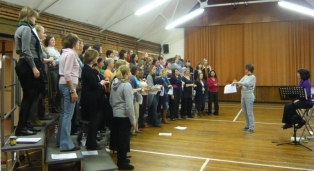
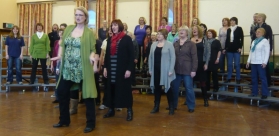
fascinatingrhyI spent last weekend with Fascinating Rhythm near Bristol for their chorus retreat. Their director, Jo Dean, has been with them two years, and they are at that productive point where they have settled into a secure working relationship, but not into a rut. Indeed, one of the minor themes of the weekend was helping Jo feel safe to keep a lighter grip on the reins now that she is getting a more immediate and nuanced response from the singers – several gestures that were needed when the chorus was first learning to read her can now be reduced and/or dropped entirely.

One major theme that emerged was that many aspects of the way you deliver a performance are contingent rather that fully definable in advance. If one part leads into a phrase, the other parts need to respond to the vocal tone they use that particular occasion, for instance. Likewise, the length of a grand pause depends on the energy and manner of release of the sound that precedes it. Come back in too soon and the audience won’t be ready for you; leave it too long and their attention will wander; gauge it right and they will meet you at the start of the next phrase.

Unsynchronised Singing

One of the perennial challenges of singing in small ensembles is simply singing together. It’s one of the primary marks of competence, second only probably to tuning. And, like tuning, underneath the basic observation that it is or isn’t working are a whole host of different types musical problems. I have become increasingly interested recently in listening for the details of poor coordination in an ensemble as a means to diagnose how to help them cure it.

I’m thinking here specifically of ensembles that sing without a director, I should add. In theory, having all singers coordinate with the gestures of a single individual out front should solve this problem. In practice, of course, synchronisation is an issue for choral groups, too. Sometimes this arises from the types of problem listed here, but sometimes it arises from things the director is doing, so it’s something of a separate question.

So far, I have identified the following ways of not singing together:

A Champion Evening

coachingamershamOn Tuesday I had my first coaching session with Amersham A Cappella since they won both the Good Housekeeping Choir of the Year competition and the LABBS chorus championship within two weeks of each other last October. They are still wearing the extraordinarily broad smiles they acquired then, and are pushing forward to build on the performance gains they made during the previous year.

Both of the arrangements we worked on on Tuesday were show pieces that use a lot of the techniques of contemporary a cappella instead of (and/or in addition to) the techniques of core barbershop. So, homophonic close-harmony textures appeared somewhat sparingly, to be replaced by more layered textures, largely driven by nonsense word-sounds (‘vocables’) used for their evocation of instrumental timbres. Hence, much of our work revolved around teasing out the details of these different textures, and balancing out the layers.

Love & Rhythm

heartbeat1The New Year’s coaching season launched off at the weekend with a visit to Heartbeat chorus in Cheshire, under their new director Nancy Kelsall. The goal was to kick off their preparation for the Sweet Adelines Region 31 convention in May after all the distractions of seasonal performances before Christmas. As current bronze medallists, they are approaching this with a distinct sense of purpose.

Over dinner on Saturday night, Nancy’s husband Simon remarked on a helpful comment one of his rowing* coaches used to make: that usually the moment at which you notice the problem isn’t the moment that’s causing it. So, rather than dealing directly with the issue you notice, you should analyse what has happened immediately beforehand to set it up. This applies really well to singing too: if a note is slightly flat, it’s probably the two before that lacked support; if a phrase has a ragged start, it’s probably from uncoordinated breathing.

With One Voice...

When I was about 11, we did an art project at school that involved groups of about six painting a life-size portrait of one member of the group. I initially got the job of doing the face, and I was quite pleased with the likeness I produced. However, during a later session when I was not there (I have no recollection of why I was missing), another member of the group completely painted over all my work. I was quite hurt but, typically, didn’t say anything.

This incident came to mind back in the summer, when I was commissioned to revise Clay Hine’s arrangement of ‘I’ve Got My Love to Keep Me Warm’ for The Great British Barbershop Boys’ Christmas album. I am generally reluctant to jigger with other people’s arrangements, but I was reassured that Clay was okay with me doing so, and it was simply a matter that I happened to be available to help out in the timescale they needed. Still, I didn’t want Clay to end up feeling that I’d painted over the face of his work.

The Great British Barbershop Boys: Going ‘Mainstream’

ChristmasTimeThe Great British Barbershop Boys’ Christmas album is due out on Monday, and both the media appearances and availability of samples are ramping up in anticipation. And I’m enjoying observing the responses of the barbershop world with that double vision of both a now-well-established member of it and a musicologist who has spent many years documenting it.

Predictably, there is much excitement.

Arrangers’ Workshop

NoteOrious in actionNoteOrious in action
On Sunday, a collection of arrangers from BABS, LABBS and Sweet Adelines Region 31 gathered in Birmingham for a day of honing their craft. This one of the events under the mantle of Barbershop In Harmony, and is exactly the kind of thing it’s worth collaborating over – arranging is something of a minority interest in each organisation, but between us we have a viable community of people to exchange ideas.

For this occasion, we had kind permission from Joe Liles to use a song he wrote for the Woodshedder’s Folio as a set piece for everyone to work on in advance. We had eight versions submitted in advance for workshopping, and working through these took up the bulk of the day’s activities.

Accent and Timbre

starsandstripesunionjack
There are comments going back nearly 100 years in the literature on choral music about differences in vocal sound between British and American choirs. Back in 1914, Henry Coward was making the following comments:

There is no doubt that, generally speaking, the English choral singer favours a backward voice-production (p. 39).

Of course one must always be careful to avoid excess of nasality, or more harm than good will result; but I must say that, except in two cases in the United States, where the people have an excess of nasality in speaking, I never yet heard a choir go beyond the limits of good tone in the way of nasal resonance, whereas one often hears excess of throatiness in England (p. 44).

...found this helpful?

I provide this content free of charge, because I like to be helpful. If you have found it useful, you may wish to make a donation to the causes I support to say thank you.


Archive by date

Syndicate content Syndicate content