A Cappella

LABBS Convention 2012

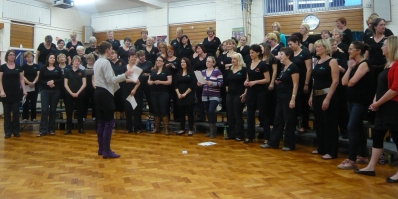
The new convention venueThe new convention venueThe weekend saw the Ladies Association of British Barbershop Singers assemble at the Telford International Centre for their 36th Annual Convention. This was the first convention at this venue and, while in some ways it wasn't ideal (such as the limited availability of hotel space in walking distance), it did provide a very kind and honest stage for the singers to perform on. All the ensembles sounded like they were able to produce what they had prepared there without distraction and everyone I spoke to confirmed they had experienced it as a good performance environment. The team running the sound system deserve to feel very pleased with their work over the weekend.

Another Windsor Wednesday

windosr2

Wednesday took me back to Windsor for a second visit to the Royal Harmonics. In some ways it feel like no time at all since I was last with them, but I couldn't help but notice that it was light when I arrived for my previous visit, but this time night had already fallen.

It was a pleasingly productive evening's work, with focused attention on several different pieces covering a wide range of musical and vocal issues. Their director, John Palmer, had some very clear agenda items for the songs he had picked to work on, but at the same time balanced his areas of interest with an openness for my diagnoses of a song's highest priorities for work. Sometimes the areas I picked up as the most important for attention were the same as the ones he had ear-marked to work on, whilst sometimes I brought up things that had not particularly been on his radar; either case was useful and interesting.

Nota Bene

notabeneMy coaching trip to Ireland continued with a day’s work near Dublin with Nota Bene quartet. They have formed under this name relatively recently, though three of them competed last year in Galway under a different name, and two have sung together in quartet for nearly five years now. This kind of profile offers both specific challenges such as adjusting existing vocal relationships to take account of the new singers’ voices and ways of feeling music, and specific advantages, with the know-how of the more experienced quartet singers supporting the newer additions.

Bristol Week

BS7pic

Thursday evening was the first of three coaching trips to Bristol in the space of a week. Entirely a coincidence as it happens, but I am going to feel properly up to date on all the news from that part of the world by the end of it. This first trip was to coach Bristol Fashion, with whom regular readers will know I have been working a couple of times a year for three years now.

I commented last time I worked with them how gratifying it is to have a sense of building on skills that have been embedded in the months between visits, and I couldn't help but notice them using exercises in their warm-up that we had introduced back in May. I'm sure they do this when I'm not there to see it too!

Some Help in Harmonising...

I recently received an email with the subject line 'Please help me to harmonise', and I thought: well, yes, that's what I do! I'll let my correspondent say in her own words what in particular she'd like help with:

In January I took up singing in an A Cappella group. I find singing in a harmony group difficult at present and I am sure that it is all in my head.

I am singing baritone and have no problem at all learning my part, I sing well when I am grouped with the other baris in my group and we sound great as a unit. It's when we are split up and I end up having the lead part sung loudly in my ear, I just can't cope because all I can hear is the lead part... I would love to be able to hear the chord that all the parts make up to help me gel in this chorus.

Now my first thought is: don't be down-hearted, this is a perfectly normal experience in the first few months of singing a cappella harmony. One of the reasons I wanted to respond publicly was because there will be loads of other people saying either, 'Yes, that's me too!' or 'Yes, that was me when I first started!' So message number 1: hang on in there, this is something you do get better at over time.

Extreme Quartetting

I spent Saturday afternoon and evening in Nottingham at the British Association of Barbershop Singers’ Harmony College, at which I had been invited to judge the contest that formed part of a stream called ‘Extreme Quartets’. This is a model that takes the idea of chamber music as practice gadget, and simultaneously supports and intensifies the experience.

The way it works is this. Participants learn a great pile of music in advance (in this case, six songs), and then spend the weekend receiving coaching on them, both as a chorus – re-living the original invention of the barbershop chorus as a way to deliver coaching to lots of singers simultaneously – and in a variety of quartet line-ups. The contest had a preliminary round in the afternoon, with the top two quartets and a randomly-picked third going through to the final in the Saturday evening show.

Close-Harmony Singing Intensive

mozfest2012

It is absurd to expect a group of amateur singers, two-thirds of whom have never sung together before (and some of whom have not sung since they left school), to learn a four-part close-harmony arrangement from scratch in less than three hours, isn't it? And you wouldn't necessarily expect them to keep the tonal centre rock steady throughout, would you? And it would certainly be too much to expect them to perform it from memory at the end of the afternoon, yes?

There is often a moment in the days before one of the workshops that Magenta periodically offers for our local Moseley Festival, that I too think this is impossible.

Coaching with Phoenix

Phoenixjul2012Tuesday evening saw me back with Phoenix chorus for an evening's coaching - nice not to leave it for six years before a re-match this time! My primary remit was to work with them on an arrangement they had commissioned from me last year, and which they have scheduled to perform in a couple of shows this September, though we also looked at a couple of other pieces to refresh our musical palate.

Most of our work was in the realms of musical characterisation, bringing out texture and colour implicit in the musical shapes. I always tend to think of this process as one of sculpting: developing the flat canvas of beautiful vocal tone into a more three-dimensional musical shape.

...found this helpful?

I provide this content free of charge, because I like to be helpful. If you have found it useful, you may wish to make a donation to the causes I support to say thank you.


Archive by date

Syndicate content Syndicate content