A Cappella

Discoveries with Silver Lining

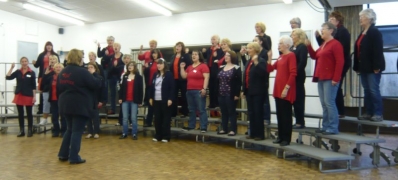
SLjun13Saturday took me over to Coventry to work with Silver Lining chorus. I have visited them a number of times over the years, though not for a while, and they have developed considerably since my last visit - both in size and assurance. Their director, Sara Jackson, had sent me a to-do list of things it might be useful to work on, with the proviso that if I identified something I felt was more important or urgent, that could queue-jump.

The way this played out in practice was that I went in with some specific plans for coaching tactics right from the get-go, and was then able to diagnose and start to address other coaching needs from within those activities. It felt like an efficient way of working.

LABBS Directors Day

The delegates in songThe delegates in songSunday saw 95 chorus directors, assistant directors and directors-in-waiting from the Ladies Association of Barbershop Singers convene in Birmingham for the day. That is a lot of people, I should add. We had run a consultation exercise last autumn which not only fed much of the content of the day, but had led us to project an expected attendance of about 70 delegates, and even a month ago that still looked about right.

Don't get me wrong - I was delighted with the huge response to the day. But the last flourish of registrations before the deadline had me worrying over the published programme and whether we had left enough time for the breaks, and how the noise levels were going to be in discussion sessions. One of the great things about working with directors, though, is that they understand such dilemmas and readily cooperate to make the logistics work. We also had the splendid 'sheep dog' skills of Anne Potter, who rounded everyone up regularly to keep us running to time.

Cheshire Chord Coaching

CCCThursday took me up the M6 to Warrington for my second trip north-west in two days, this time to work with current LABBS chorus champions, Cheshire Chord Company. We were working on two songs at different stages of development - the first only recently off the page and thus still at a stage where it could be pulled around and played with considerably, the second a show-piece already in the performing repertoire where the task was to refine the execution of the vision.

The Red Rosettes, Exploring the Song

redrosettes1

Last night was the first of two consecutive trips north-west, this one to coach the Red Rosettes in Preston. Much of the evening was dedicated to bringing out the expressive shape of a show-piece they are currently learning. But we also spent some time on the song they had used for a recent Learn to Sing course in order that their new recruits could have their first experience of being coached.

Chatting to a couple of these singers afterwards gave an interesting insight into what this experience was like for them. One spoke of the way she found it initially very challenging as it was asking her to let go of the way she had learned to do things. I thought this was a beautifully simple and to-the-point way of articulating that process of moving up from the basic operations of a new skill. Fortunately she seemed ready to take on the challenge and looked all lit up with that glow you get from achieving something new.

BABS in Bournemouth

The Bournemouth International Centre: The scene of my introduction to barbershopThe Bournemouth International Centre: The scene of my introduction to barbershopThe weekend saw the British Association of Barbershop Singers back in Bournemouth for their annual convention. This was a bit of a nostalgia-fest for me, as it was the venue of my first ever barbershop convention in 1996, and we were even staying in the same hotel as we did back then. And of course, on the first really beautiful weekend of the year after a cold winter and late-starting spring, the logical thing to do is to go to the seaside - and then spend most of the day in halls with no natural light.

The first big story of the weekend was the way that younger quartets dominated the contest, taking four of the six spots in the final, and two of the medals. Only two of these were strictly speaking 'youth quartets' as defined for contest purposes, but new champion quartet The Emerald Guard included three faces who first made their mark in British barbershop through the Youth Quartet Contest, and the other three - The QuarteTones, Taglines and current youth champs, Park Street - are all associated with university barbershop groups.

Capital Embellishments

capemb

Wednesday evening took me down to work with my friends in West London, Capital Connection. Our task was to work on two new contest songs which are quite well sung in, and thus ripe for enhancement - adding colour, nuance and emotional depth to an already well-shaped delivery.

Although it is 6 months since I last worked with the chorus, the intensive period back in the autumn of several visits in quick succession had left its mark with our working methods. It felt like we were able to cover a considerable range of musical issues in a short time: melodic flow, harmonic colour, texture and expressive register, rhythmic feel, tension and release. Actually, now I write it out, I am even more impressed by the rate at which the singers were absorbing and applying ideas to their performance.

A topic that came up with both songs was embellishment.

On Consecutive 5ths and 8ves

consecegOne of those penny-drop moments came to me when, as an undergraduate playing through some music I had written as a younger teenager (and finding it both better and worse than I remembered - does this happen to everyone when revisiting the efforts of their younger selves?), I came across a bit I'd always had to play quite carefully to make it sound okay. It could work all right, but if you didn't place it just so, it could sound a bit naff.

In the time between writing this music and revisiting it, I had been taught the concept of consecutive 5ths and 8ves, and the importance of avoiding them. This concept now revealed to me what the problem had been with my piece of juvenilia, and simultaneously made me grasp, emotionally, why I should care about this bit of theory.

There are other schools of thought on consecutives of course. Take Noel Coward:

On Tuning and Musical Meaning

Do you ever have the experience in rehearsal where people are singing the right note, but it's sitting just a shade too high or too low for the chord to gel? If you spend any time at all working a cappella, I bet you do (if you don't, you lead a charmed life).

I’m not talking about your regular, run of the mill tuning issues here, caused by tiredness, habit or faulty vocal production. I’m talking about a specific kind of fault where an ensemble that is basically in tune horizontally doesn’t always nail the vertical tuning.

Now, you can address this problem at an analytical level, asking people to nudge their note up or down a bit to get it into true. But this approach has drawbacks:

...found this helpful?

I provide this content free of charge, because I like to be helpful. If you have found it useful, you may wish to make a donation to the causes I support to say thank you.


Archive by date

Syndicate content Syndicate content