
Add a comment
Slowing things down with SpecsAppeal
‹-- PreviousNext --›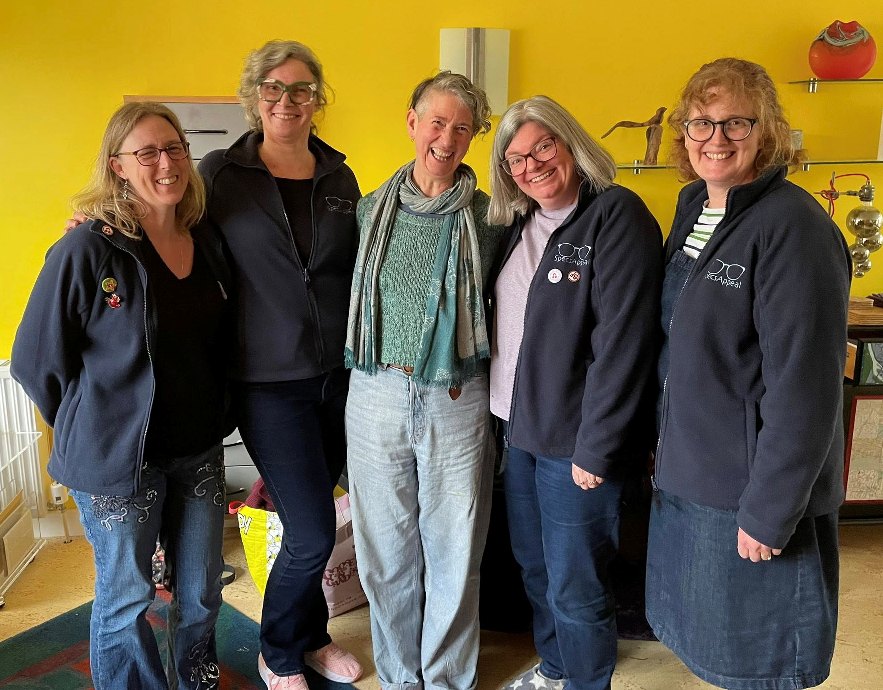
I spent Sunday with SpecsAppeal working on a combination of things that were specific to the two songs they brought with them and things that will apply to everything they sing. Unlike my difficult-to-summarise exploration of musical detail in Scotland a couple of weeks ago, we found a clear theme emerging during the day that applied in multiple different contexts: the value of taking things slowly.
The first and most literal of these recurred throughout the day: blocking passages a chord at a time, taking time to make friends with each one before you move on. In a texture where you have a four-part chord for every melody note, there’s a lot of music going on, and your brain doesn’t have time to fully absorb it all as it flies by in tempo. If you stay with a chord until you can let go of your own note and attend to the whole, your brain can make sense of it, and provide all the microadjustments to tuning, balance, tone- and vowel-match to bring it into focus.
It is immediately audible when the brains involved have reached this point, and it will then be consistently reliable when put back into tempo. The thing is here to be patient: you can’t automate this process, you have to be there in the moment with each and every chord you block. But if you take as much time as it needs to do the deep work, the benefits are much more likely to stick, whereas if you hurry through it, the previous issues with the passage (whether note errors or simply not locking in cleanly) will come back and need addressing all over again.
The need to take time also arose in musical contexts. The imperatives of a song’s forward momentum sometimes result in skating over moments that need to land securely. Cadence points need to secure the end of a phrase before bouncing off into any embellishing features. Or if a word is highlighted by breaking off into silence, it still needs to sound fully – too staccato and you only hear the gesture, not the meaning that the gesture is intended to emphasise. A similar principle arises with punchlines: you need to give time for people to hear them and respond to them before moving on.
A general principle that applied to all of these cases was to listen for the chord locking in before moving on. Sometimes that took blocking it in isolation to bring it into focus before putting it back in context, other times it was just a matter of redirecting attention within the tempo and flow. Asking what emotional work a particular chord is performing within the narrative was a useful way to make sure it received the attention it deserved.
The third context in which we thought about slowing things down was in managing adrenaline levels in preparing for performance. Knowing that walking onto stage is going to add an extra burst of adrenaline to the system, the preparation time needs to focus on appealing to the parasympathetic nervous system so that that burst lifts you into peak performance rather than overshoots you into the distractions of over-arousal.
You can do a lot of this work in your interactional behaviour: keep your speech and movements slower and quieter than usual, and look to calm each other down if you see excitement starting to build too early. (It’s much easier to spot this in someone else than yourself.) Your warm-up activities can also help: slow, mindful listening exercises like the ones we had been working on help ground you musically and connect into each other.
It was also interesting to observe the effect that singing lying on their backs (with legs bent and feet flat on the floor) had on the quartet. They had to work hard musically to hear and connect with each other, but the tempo felt measured and not inclined to rush forward. The voices sounded a little disconnected from their full resonance but nonetheless reasonably poised. When standing up again after this exercise though, the voices sounded in great shape; all the little kinks of extraneous tension that might wobble the musical line off true had settled out while they lay down and the consistency of tone and ensemble cleaned itself up like magic.
Slowing things down, then, is in part a factor of technical development: giving the brain the time it needs to lay down new neural pathways. But it is also about the relationship with the music, and with oneself. Patience is not so much a virtue here, but an act of self-care: take the pressure off and allow yourself to live in the moment, experiencing the musical beauty without regard to your counter-productive internalised critics. Treat your own musical life with the same generosity you would wish for others.


You may also like ...
|
Node 3,034
Weight = 4. Links to Digging into the Detail with Albacappella (2), Two tags in common [256 posts have this] A Cappella, Coaching (2) 
|
Node 2,984
Weight = 4. Common link to https://www.facebook.com/specsAppealquartet (2), Two tags in common [256 posts have this] A Cappella, Coaching (2) 
|
Node 2,443
Weight = 3. Three tags in common [32 posts have this] A Cappella, Coaching, Learning (3) 
|
Node 2,394
Weight = 3. Three tags in common [32 posts have this] A Cappella, Coaching, Learning (3) 
|
