
Add a comment
A Charismatic Encounter with Blair Brown
‹-- PreviousNext --›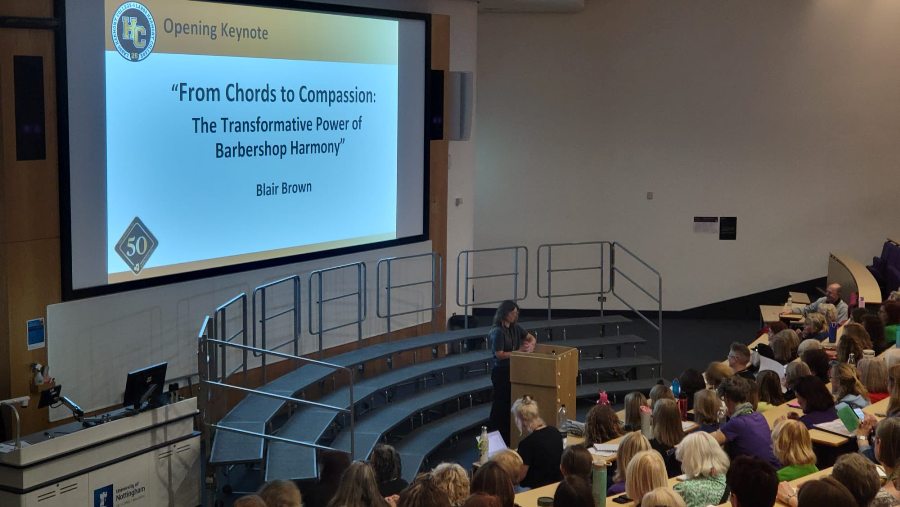
It’s a good long while since I’ve written about musical charisma, which was one of my regular topics of interest in the early years of this blog. If I’d stayed in academia, that would have been the area for my next scholarly monograph, emerging out of ideas I had to leave to one side as I wrote my book on choral conducting. But Blair Brown’s keynote speech at LABBS Harmony College got me thinking about it again.
In general culture, we tend to regard charisma as something that inheres to the individual, as a special or magical quality. However, the sociology of charisma suggests that it is something that is experienced in particular circumstances, arising from the relationships between members of a group as well as with its leader. Certainly some people are more adept at galvanising charismatic experiences within these circumstances, and indeed at facilitating their set-up, but they do it using somewhat standardised – and thus analysable – techniques rather than by any inherent magic. (Though as we shall see later, the belief in this magic is implicated in making a group susceptible to charismatic encounters.)
The key thing for the group structure is that all members should have access to each other to allow the free flow of emotional energy known as ‘flux’ or ‘communion’ (cliques are inimical to charismatic experiences). I have already commented in my previous post about this event on the interlocking relationships at HC26 that bound people from different choruses, attending different streams, into a single unified cohort. Larger groups also have potential for stronger responses, so the size of the event was also a factor.
So things were set up well for Blair to galvanise our opening plenary session into a heightened communal emotional state. Her keynote speech gave an almost textbook demonstration of the three essential elements needed to achieve this: Cause, Crisis, and Mythology.
She set up the Crisis first, to create the need for the Cause. This was articulated at one level in somewhat abstract terms: 'vacuum of empathy, ‘epidemic of apathy’, 'globalisation of indifference'. But the examples she adduced to show the severity of the crisis, and the consequent urgency for a response to it, were concrete and current. She spoke of the political situation in the US, in particular the activities of the ICE agents in the region where she lives, abducting people from the street for deportation without regard for their legal or human rights. She also spoke of the deep social divisions that handed power to an administration who would do this, and that have been exacerbated by that regime’s actions. She quoted the Pope’s public critique of this cruelty in his Easter address.
This is Real World stuff. It is so easy to get locked into our little bubbles (the ‘barbershop bubble’ is a beloved safe haven for its inhabitants), but invoking the horrors we are seeing daily in the news - and our knowledge that we were listening to someone who has to live directly within it - stripped away complacency and immediately raised the emotional temperature of the room.
(It also signalled a very marked departure from the traditional barbershop ethos of keeping religion and politics out of things in the interests of ‘social harmony’. Which of course is itself a political decision, as Clifton Boyd has adeptly analysed in his recent article about racial segregation in mid-20th-century SPEBSQSA.)
After the crisis, came the Cause: the need to find human connection. And of course the arts are built for this, they are structured generators of empathy. Blair made the point that live performance in particular carries this quality because it binds artists and witnesses together in the here-and-now. Singing to people isn’t just entertainment, that is, but a means to heal the damaging emotional separateness that underpins the politics of division. What we do as performers matters. I am reminded of Mo Field telling a chorus, ‘Your only job is to make someone in that audience feel less lonely’.
Framing what we were there to learn to do better in those terms was of course profoundly affirming. And it also gave a context for a good deal of advice about how we should go about the job of performing. We should forget about impressing people and focus on how they feel in response to our performances. We should be diligent in our preparation and honest in our delivery: if we are asking people to vouchsafe their attention we owe it to them not just to dial it in.
The charismatic Cause is typically framed as a moral or abstract good to which people should commit, and at the top level this one certainly was. It is interesting to note though how it then cascaded into specifics of craft: choice of repertoire, approach to musical detail, physical gesture in performance. And there are some interesting details from this part of Blair’s address that I may return to in future posts. But even where there were particular concrete suggestions that one could debate, the overall trajectory of the speech gave a productive way to get into dialogue with them. It’s not whether or not one should do whatever thing, but how does one approach it that best facilitates human connection? Any specific instruction may not be suitable for all circumstances, but the Cause gives a means to make decisions about when to follow it by defining our primary priority.
The third essential element of a charismatic encounter is the Mythology: the belief system that attributes special or magical qualities to a leader. This belief is what allows a group to suspend their scepticism, relax their executive control, and immerse themselves in Communion.
What was interesting in Blair’s speech is that she made no attempt to position herself as the repository of this magic, but rather presented as an apostle of a leader who is already invested with this kind of mythology in barbershop world. She told the tale of her own introduction to barbershop, as a student about to go to university, attending the concert of a group conducted by the person she would be studying with. She had never heard of any of Jim Henry’s champion barbershop ensembles, either quartet or chorus, he was just a name on a faculty list. Her story of listening to the Ambassadors of Harmony for the first time was a classic account of a Damascene conversion: she was transfixed, fascinated, viscerally thrilled, and the experience changed her life.
She went on to talk about the qualities in Jim’s teaching and directing that make him so compelling: he is all about heart, about meaning, about the Why of things. Which of course is why he too is good at facilitating charismatic encounters, the Why of things being at the heart of an effective Cause.
It is also interesting to reflect that, when one is in the middle of a charismatic encounter, you know that your experience is shared. The standing ovation at the end was a bit of a clue, as were the comments throughout the weekend about how inspiring the keynote was. But we knew before that, you could feel the atmosphere in the room, it was utterly electric. How do we do that? How do I sense other people’s emotional state when I am sitting quietly amongst them without being able to detect much of the typical signals of emotional state such as facial expression, body language, or vocal tone?


You may also like ...
|
Node 3,056
Weight = 4. Linked from On Conventionalised and Meaningful Gestures (4) 
|
Node 3,055
Weight = 4. Linked from On Repertoire and Empathy (4)
|
Node 1,303
Weight = 3. Links to Massed Voices and the Charismatic Encounter (2), One tag in common [51 posts have this] Charisma (1)
|
Node 1,104
Weight = 3. Links to How to be Charismatic when you're not even there (2), One tag in common [51 posts have this] Charisma (1)
|
